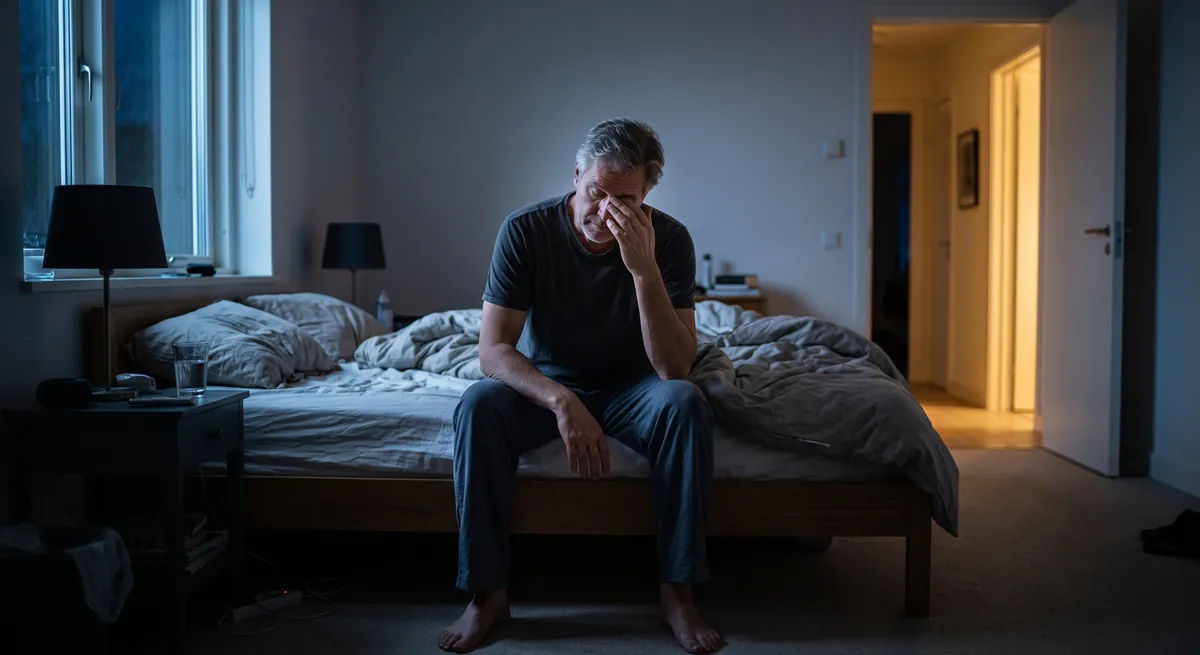
It usually starts with a single trip. Then one night it’s two, and before long you’re lying awake at 4 a.m. after the third, doing the arithmetic on how much sleep is left. For a lot of men past 50, the assumption is automatic: it must be the prostate.
Sometimes it is. Research on nighttime urination keeps finding, though, that the prostate is often not the main driver, and men who treat only the prostate can end up just as tired as before.
What counts as a problem
Waking to urinate has a medical name, nocturia, which simply means getting up from sleep to pass urine and then going back to bed. Once a night is common at any age and rarely worth worrying about. According to the Cleveland Clinic’s overview of nocturia, getting up once or twice can be normal, and it becomes worth a conversation with a doctor when it happens more often than that and bothers you.
Two or more trips a night is where sleep starts to suffer in a way people feel the next day. Population studies suggest roughly 20 to 30 percent of adults between 50 and 70 are up at least twice a night, and the share climbs with age.
Why the prostate gets the blame
The prostate is a walnut-sized gland that wraps around the urethra, the tube that carries urine out of the bladder. In most men it slowly grows from middle age onward, a non-cancerous condition called benign prostatic hyperplasia, or BPH.
As it enlarges, it can squeeze the urethra. The bladder has to push harder, often doesn’t empty completely, and over time its muscular wall can become irritable and signal “full” sooner than it should. A bladder that’s already partly full at bedtime, and that complains early, will wake you up.
That’s why nocturia is so common in men with BPH. In clinic studies of men over 60 with an enlarged prostate, around four in five were getting up at least twice a night.
The more common culprit: too much urine at night
When researchers measure how much urine people actually produce overnight, most of those with nocturia turn out to have nocturnal polyuria, meaning the kidneys are simply making too much urine while they sleep. In older adults, the threshold doctors use is more than about a third of the day’s total output being produced at night.
In studies of men already being treated for an enlarged prostate who still got up repeatedly, roughly three out of four had this pattern. That would explain why prostate treatment often disappoints on this one symptom. In one placebo-controlled trial of a standard prostate medication, nocturia improved less than any other urinary symptom, and prostate surgery tends to cut nighttime trips by only about one.
If the bladder is filling with too much urine, widening the outflow won’t stop you from waking up to empty it.
Several things push urine production into the night. With age, the body releases less vasopressin, the hormone that normally tells the kidneys to hold back water during sleep. Fluid that pools in the ankles and legs during the day gets reabsorbed into the bloodstream once you lie down, and the kidneys filter it out. Drinking late, especially alcohol and caffeine, adds to the load. So do diuretic “water pills” taken in the evening.
Sleep apnea and other hidden causes
Obstructive sleep apnea, in which the airway repeatedly collapses during sleep, is one of the more overlooked causes. Each time a sleeper strains to breathe against a blocked airway, the pressure change stretches the heart, which responds by releasing a hormone that tells the kidneys to shed salt and water. The result is more urine, plus repeated arousals that make you notice it.
Treating apnea can make a real difference. In one study, people using a CPAP machine went from about two and a half nighttime trips to fewer than one, although other studies have found smaller effects.
Nocturia can also be an early sign of something else entirely: poorly controlled diabetes, heart failure, high blood pressure or kidney problems. And sometimes the bladder isn’t the reason you woke up at all. Light or broken sleep wakes you, and the trip to the bathroom becomes a habit.
How to tell the patterns apart
The most useful tool is a bladder diary. For two or three days, write down when and how much you drink, and every time you urinate, note the time and measure the volume with a jug. It’s tedious, but it shows a doctor whether you’re producing a lot of urine at night or passing small amounts often.

The other clue is what comes with the nighttime trips. On its own, nocturia points toward urine production or sleep. When it comes with a weak stream, straining to start, a flow that stops and starts, or the sense that the bladder never quite empties, the prostate becomes a more likely suspect.
Urologists capture those symptoms with a standard seven-question questionnaire, the International Prostate Symptom Score, or IPSS, which rates each one from 0 to 5. You can score yourself with a free online IPSS calculator and bring the result to your appointment. A total of 0 to 7 counts as mild, 8 to 19 as moderate and 20 or more as severe. The score doesn’t diagnose anything, but a high result driven by emptying symptoms tells your doctor where to look first.
What helps, depending on the cause
If the diary shows most of your urine is produced at night, the first changes are simple:
- Drink less in the evening, especially in the last hours before bed, and go easy on alcohol and caffeine.
- If you take a diuretic, ask whether it can be moved to the morning, at least six hours before bedtime.
- If your ankles swell by evening, put your feet up for an hour or so in the late afternoon, or ask about compression stockings, so the fluid clears before you go to bed.
If emptying symptoms dominate, prostate medications or procedures can help, and a urologist can talk through the options. If you snore heavily, gasp at night or wake unrefreshed, ask about a sleep study.
When to see a doctor sooner
Get checked promptly, whatever your nighttime count, if you notice blood in your urine, pain or burning when you pass it, fever, or a sudden loss of bladder control. Being unable to urinate at all is an emergency. Unusual thirst, weight loss or new swelling in the legs alongside nocturia are also worth raising soon.
Where to start
Plenty of men put up with broken nights for years on the theory that it comes with age and an aging prostate. A few nights of keeping a diary and a few minutes on a symptom questionnaire can tell you and your doctor more than that guess ever did, and point treatment at the cause you actually have.